
Checklist: From combustion engine to electric forklift truck – how to master the switch
A fleet contract coming to an end, a machine reaching the end of its service life, a company about to move to a new site – often it is a very specific event that raises the big question: How should the fleet move forward – and with which drive technology? This decision needs to be well considered, as it will shape operations for years to come.
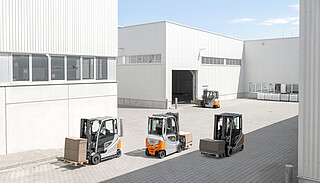
Anyone operating a fleet today knows that external influencing factors are increasing. Emissions requirements, rising energy costs and sustainability targets along the supply chain all impact warehouse operations. Forklift trucks with internal combustion engines are increasingly being replaced by electric ones. This raises the question, particularly with new acquisitions: What comes next, and which drive should be chosen? How can you ensure a smooth transition while operations continue? To determine which technology is right for your fleet, it is essential to take a closer look at your processes and needs before making a decision.
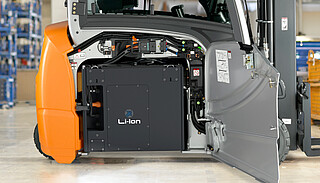
For many, the obvious alternative to the combustion engine is the electric forklift truck with a lithium-ion battery. It has a strong presence in the media, is technologically impressive and is heavily promoted by manufacturers – and with good reason: lithium-ion technology has genuine advantages that justify the hype.
Those wanting to move away from combustion engines therefore often think in opposites: combustion was yesterday, and the lithium-ion battery is the logical next step. However, another technology is overlooked: the lead-acid battery. Lead-acid technology is by no means inferior; it is simply different: proven, reliable and worthy of serious consideration by many companies and processes.
So, alongside the combustion engine, there are essentially two distinct technologies to choose from. But which fits which company?
Step 1: Take a look at your own processes
Before deciding which technology is right for your fleet, it is worth taking a look at your own processes. The following key questions can help:
- How many operating hours is the forklift truck in use? How much charging time is available – and when?
- Are there breaks during which interim charging would be possible?
- Is work carried out in a special environment, e.g. in cold storage areas or outdoors?
What matters is not only the question of how charging fits with your current processes. When making the switch, it is also worth looking ahead: How should the charging process be integrated into the workflow in the future?
Step 2: Understand battery technologies
Once there is clarity about the processes, it is worth taking a closer look at the battery technologies mentioned. There is no one-size-fits-all solution. The best technology is the one that fits your own operations.
The lithium-ion battery scores particularly well where maximum availability and flexible charging times influence overall costs. The battery can be interim-charged at any time – even briefly during a break. This means: no battery change is necessary during ongoing operations. Especially in multi-shift operations, short charging times increase availability and reduce organisational effort. In addition, the charging process is up to 30 per cent more energy-efficient. Over its entire service life, lithium-ion batteries can reduce energy costs by 30 per cent compared to lead-acid batteries.
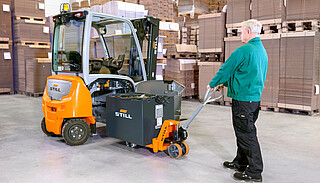
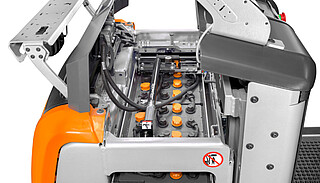
The lead-acid battery is an established technology with a long track record, both among manufacturers and customers. For companies with predictable operating and charging times, for example in single-shift operations, it is therefore a solid, economical choice – also because of the lower purchase price. Add to this an often underestimated advantage: the high dead weight of the lead-acid battery also serves as a counterweight in the forklift truck. Those who opt for this type of drive should, however, plan for regular maintenance and higher energy losses during charging in day-to-day operations. Both can increase running costs.
Step 3: Factor in the charging infrastructure
When switching to electric forklift trucks, the charging infrastructure must be part of the planning from the very beginning. Depending on the chosen technology, the requirements differ considerably. Charging lead-acid batteries produces gas, which is why a ventilated charging area designated specifically for this purpose is necessary. In addition, the charging process should always be completed in full: if it is interrupted too early or the battery is only partially charged, this can shorten its service life. A charging cycle therefore takes several hours – regardless of the time of day at which it takes place. Lithium-ion batteries are more flexible: they can be charged decentrally at safe charging points directly at the place of use, whenever a break occurs.
For larger fleets, an intelligent charging management system should also be planned in. It keeps track of the charge levels of all vehicles, distributes the available charging capacity as needed, and plans the available capacity ahead of time. All of this helps to keep not only the availability of the vehicles in view, but also the energy costs. Clarifying all of these questions early on not only creates a solid foundation for economical operations – it also avoids costly retrofits.
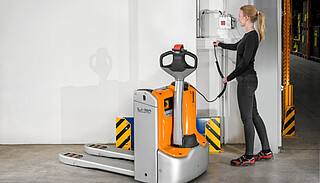
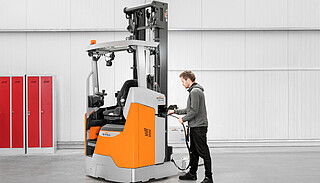
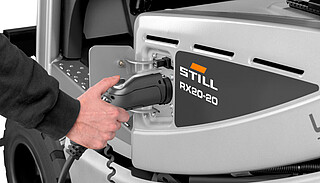
The aim should be to integrate the charging processes as smoothly as possible into the existing workflow – not the other way round. With lithium-ion batteries, the onboard charger helps here: the charger installed in the vehicle charges the battery directly from an ordinary 230 V socket, without the vehicle having to travel to a fixed charging station. Larger models that require more energy are also equipped with a 16 A plug. This means a break at the place of use can be utilised for interim charging – provided a suitable charging point is available. A specially set-up charging area, as is often required for lead-acid batteries, is therefore not always necessary.
Step 4: Organise the transition
A fleet conversion does not have to happen overnight. A phased introduction is perfectly possible – and often even more sensible. This allows experience to be gathered, processes to be adjusted, and employees to be trained step by step before the entire fleet is converted. This is a step not to be underestimated, because: training creates confidence and acceptance.
Anyone who has previously worked with a combustion engine every day needs to rethink when switching to an electric forklift – not because the operation is fundamentally different, but because a different understanding of charging cycles, ranges, and the correct handling of the battery is required. Involving the team early and preparing them well avoids uncertainties in day-to-day operations and makes the transition significantly smoother.
Planning also involves drawing up a realistic timetable. When do the various contracts expire? Which vehicles will be replaced first? How will the transition phase be managed, during which both types of drive system may still be in operation? It is important to clarify these questions at an early stage.
When it comes to performance, businesses no longer need to compromise. Electric forklift trucks now match the performance levels typically associated with internal combustion engines, and they offer several advantages in many applications: they are quieter, emission-free, and require less maintenance. Switching to electric forklift trucks is therefore not a compromise, but a genuine improvement to day-to-day operations in most cases.
What the switch really costs – and what it delivers
Anyone looking only at the purchase price sees only a fraction, not the whole picture. What is decisive is the Total Cost of Ownership (TCO): in addition to the purchase price, this includes costs for maintenance, energy, and potential downtime. Each battery type has its own very specific advantages and disadvantages:
- Lead-acid batteries: lower purchase price, but higher running costs due to maintenance, energy consumption, and the need for a battery room, because depending on fleet size, battery type, and charging capacity, additional requirements may arise for the charging area, ventilation, and safety.
- Lithium-ion batteries: higher purchase price, but low-maintenance and with lower operating costs over the service life. An onboard charger also allows flexible charging directly from ordinary sockets. Depending on the usage profile, the TCO can equal that of lead-acid batteries, or lithium-ion batteries can even become the more economical alternative. Compared to combustion-engine forklift trucks, the savings from higher energy efficiency and lower maintenance costs even exceed 50 per cent.
Regardless of the chosen battery technology, electric forklift trucks have two fundamental advantages: they emit no exhaust fumes, often making them the only permissible solution in sensitive sectors such as food and pharmaceuticals. Furthermore, the electric drive is significantly quieter than an internal combustion engine, which protects the hearing of everyone involved and improves the perception of acoustic warning signals in the warehouse.
Conclusion: The journey is worthwhile – if it fits your operations
Switching from a combustion engine to an electric forklift truck does not mean venturing into the unknown. It is a decision that can be planned – provided you closely examine the requirements of your operations, compare the technologies honestly and consider your infrastructure from the outset.
STILL will be happy to support you in your decision-making process with an individual fleet check, concrete TCO calculations and experience gained from numerous conversion projects.
Subscribe to our blog!
As soon as a new article is published, we will notify you! You can unsubscribe at anytime.